Salaah
There are three mentioned in the Qurʾān: Ṣalāt Al Fajr, Ṣalāt Al Wusta, Ṣalāt Al Isha. Al Wusta is a place, So that reduces it down to two. Al Fajr is regarding the Al Fajr at the end of Laylatul Qadr. So that reduces it down to one – Salat Al Isha. What’s that? It could possibly just be sitting through the night reading and studying the Qur’an, is that for begging Allah to forgive whilst still committing sins over and over and not doing good deeds to have better? No. Indeed it’s not.
Wasata means the Center.
2:143 – Ummatan Wasata (Central Community)
If this Ṣalawaata are places as per Sunnis in this verse:
ٱلقرءان سورة الحج 40
ٱلَّذِينَ أُخْرِجُوا۟ مِن دِيَـٰرِهِم بِغَيْرِ حَقٍّ إِلَّآ أَن يَقُولُوا۟ رَبُّنَا ٱللَّـهُ وَلَوْلَا دَفْعُ ٱللَّـهِ ٱلنَّاسَ بَعْضَهُم بِبَعْضٍ لَّهُدِّمَتْ صَوَٰمِعُ وَبِيَعٌ وَصَلَوَٰتٌ وَمَسَـٰجِدُ يُذْكَرُ فِيهَا ٱسْمُ ٱللَّـهِ كَثِيرًا وَلَيَنصُرَنَّ ٱللَّـهُ مَن يَنصُرُهُۥٓ إِنَّ ٱللَّـهَ لَقَوِىٌّ عَزِيزٌ
[They are] those who have been evicted from their homes without right – only because they say, “Our Lord is Allah.” And were it not that Allah checks the people, some by means of others, there would have been demolished sawaami’, biya’, salawaat, and masaajid in which the name of Allah is much mentioned. And Allah will surely support those who support Him. Indeed, Allah is Powerful and Exalted in Might.
Al Ḥajj (22), ʾĀyah 40
Then why can’t As-Salaah in this verse be about a place rather than an act of prayer:
ٱلقرءان سورة النساء 43
يَـٰٓأَيُّهَا ٱلَّذِينَ ءَامَنُوا۟ لَا تَقْرَبُوا۟ ٱلصَّلَوٰةَ وَأَنتُمْ سُكَـٰرَىٰ حَتَّىٰ تَعْلَمُوا۟ مَا تَقُولُونَ وَلَا جُنُبًا إِلَّا عَابِرِى سَبِيلٍ حَتَّىٰ تَغْتَسِلُوا۟ وَإِن كُنتُم مَّرْضَىٰٓ أَوْ عَلَىٰ سَفَرٍ أَوْ جَآءَ أَحَدٌ مِّنكُم مِّنَ ٱلْغَآئِطِ أَوْ لَـٰمَسْتُمُ ٱلنِّسَآءَ فَلَمْ تَجِدُوا۟ مَآءً فَتَيَمَّمُوا۟ صَعِيدًا طَيِّبًا فَٱمْسَحُوا۟ بِوُجُوهِكُمْ وَأَيْدِيكُمْ إِنَّ ٱللَّـهَ كَانَ عَفُوًّا غَفُورًا
O you who have believed, do not approach As-Salaah while you are intoxicated until you know what you are saying or in a state of janabah, except those passing through [a place of prayer], until you have washed [your whole body]. And if you are ill or on a journey or one of you comes from the place of relieving himself or you have contacted women and find no water, then seek clean earth and wipe over your faces and your hands [with it]. Indeed, Allah is ever Pardoning and Forgiving.
An-Nisāʾ (4), ʾĀyah 43
And why can’t this verse be about places, why can’t Al Wusta be a middle place rather than “middle of the day”:
ٱلقرءان سورة البقرة 238
حَـٰفِظُوا۟ عَلَى ٱلصَّلَوَٰتِ وَٱلصَّلَوٰةِ ٱلْوُسْطَىٰ وَقُومُوا۟ لِلَّـهِ قَـٰنِتِينَ
Preserve upon As-Salawaat and [in particular] the middle As-Salaah and Rise to Allah devoutly.
Al Baqarah (2), ʾĀyah 238
Where does the Qur’an ever refer to a “middle of the day” (al-yawm al-wusta) explicitly?
Al-Wusta is the superlative adjective of Aṣ-Ṣalaat, so why can’t Aṣ-Ṣalaat be a place but an act? Especially since it’s paired with Al-Wusta anyway. Aṣ-Ṣalaat would just be the definitive noun (name of the place. We see this pattern in 5:2, Al-Baytal-Ḥarāma, noun and adjective, Al-Bayt meaning House. Aṣ-Ṣalaat: Noun; Al-Wusta: Adjective.
If Aṣ-Ṣalaat IS indeed a timely action in this verse then I will concede to the idea that Al-Wusta here means middle of the day, but the fact that the Qur’an itself doesn’t specify whether Aṣ-Ṣalaat is exclusively a timely action or place, but rather grammatically it’s in the Definitive Noun form (it’s not Ṣallī (verb) or Muṣalla (person)), shows that it could be inclusive of it being the place where Aṣ-Ṣalaah action is done, especially it being paired with Al-Wusta which isn’t exclusively temporal but generally spacial, thus Aṣ-Ṣalaat Al-Wusta is the Center place called Aṣ-Ṣalaat where Aṣ-Ṣalaah is done. Regarding the ritual aspect, the night vigil (Al-Layli Fa-tahajjud) after Isha, during Al-Layl, is not for ritualised begging through mindless parroting, it’s to ask Allah to enter at a Righteous Entrance (mudkhala sidqin), that the Truth has come and Falsehood has diminished, these verses clearly have a future application so they ARE in fact during the Hour, because what would be the point now to say “Truth has come, falsehood has vanished” many times when there is still clearly falsehood existing being masqueraded as the truth? That is in fact in and of itself baaṭil in the sense that it’s useless for now to say.
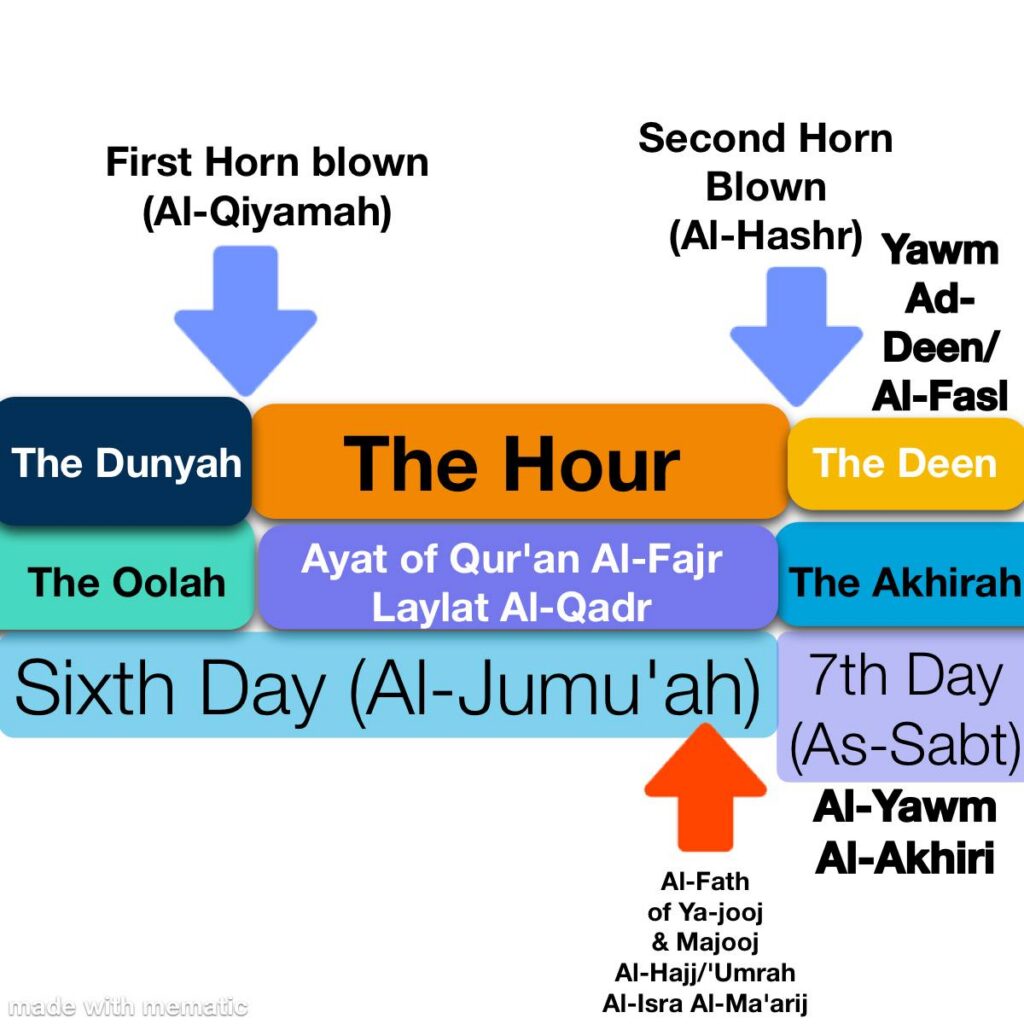
So basically the Hour chronology as follows:
Aṣ-Ṣalaatash-Shamsi (17:78)
Allayli (17:78), Laylatil-Qadr (97:1), Layālin ʿAshr (89:2)
Qurʾānal-Fajri (17:78), Wal-Fajr (89:1), Matlaʿil-Fajr (97:5)
Clear evidence that Al-Fajr is after the night of determination, and that’s Sūrah Al Qadr itself, clear and explicit. Al-Fajr is mentioned in these different verses. why would all the instances of Al-Fajr be all different fajr? they’re all about the same one, including the one about siyam (2:187). Al Fajr instances are 2:187, 89:1, 17:78, 24:58, 97:5.
Mashhood (Attested)
11:103 – a Day. 17:78 – The Fajr’s Qurʾān. 85:3 – everything?
Regarding the physical movements especially Sajdah, check this article:
https://quranicwisdoms.com/articles/sajdah-and-cosmology/
It clarified Sajdah itself isn’t a physical action, not a physical verb, but a mental behaviour, a proverb, expressed by physical movement, all the creation expresses this state in their own ways, humans and jinns are the only ones not forced to remain in Sajdah 24/7, whilst the sun and moon are programmed to, there’s no mention of prostrating on the 7 bones/joints, that only comes from Ahadith based on pagan ancient Egyptian practices.
There are those who say that Sajdah is a physical action whereby you put your head on the ground with your butt in the air, however, this specific description for Sajdah isn’t actually described in the Qur’an, not even for humans, this is an innovated meaning and description from the ahadith fabrications.
In regards to Rafa Al Yadayn and placement of hands
https://vm.tiktok.com/ZNRsTVwfA/
If the exact method of the ritual prayer was so important and was fardh, then why didn’t the Qur’an ever have details on it or any fully complete and traceable hadith from the Nabi detailing it, as the ritual became more and more dispersed from person to people to other people and some differences orally arose in the method of ritual prayer as a result of oral mass transmission to different people?
Ritual
A ritual by definition is an action that is pre-meditated and slowly strategized, an action that is routinely done on repeat.
The verb rattala has a very similar meaning in Arabic as the word ritual, though it’s in reference to the recitation of the Qurʾān. The word ritual itself seems to have originated from the Arabic verb rattala, the Qurʾān uses this verb and also uses the verbal noun of this word which is tarteel. So there is indeed a ritual in the Qur’an as per the following verse:
ٱلقرءان سورة الفرقان 32
وَقَالَ ٱلَّذِينَ كَفَرُوا۟ لَوْلَا نُزِّلَ عَلَيْهِ ٱلْقُرْءَانُ جُمْلَةً وَٰحِدَةً كَذَٰلِكَ لِنُثَبِّتَ بِهِۦ فُؤَادَكَ وَرَتَّلْنَـٰهُ تَرْتِيلًا
And those who disbelieve say, “Why was the Qurʾān not revealed to him all at once?” Thus [it is] that we may strengthen thereby your heart. And we have composed a singular composition.
Al Furqān (25), ʾĀyah 32.
There’s not a single verse in the Qurʾān that puts rattala/tarteel with the word Ṣalāh.
Though this ritual is not a set of movements, it is simply reciting this Composition slowly with due diligence.
The following verses also instruct “rattalin Al Qurʾān tarteelan” when arising at The Night (Al-Layl), though this specific instruction is for a specific group of people of a specific person titled Al-Muzammil and appears to have a future application since it’s in the present tense and the Qurʾān is for all of time including the future.
ٱلقرءان سورة المزمل 4-1
يَـٰٓأَيُّهَا ٱلْمُزَّمِّلُ قُمِ ٱلَّيْلَ إِلَّا قَلِيلًا نِّصْفَهُۥٓ أَوِ ٱنقُصْ مِنْهُ قَلِيلًا أَوْ زِدْ عَلَيْهِ وَرَتِّلِ ٱلْقُرْءَانَ تَرْتِيلًا
O whichever of you of Al-Muzammil: you arise at The Night except a little, half of it or you take a little of it, or you add to it and recite the Qurʾān a slow composed recitation.
Al Muzammil (73), ʾĀyāt 1-4
Just to clarify, tarteel itself doesn’t actually mean “recitation”. The following verse 29:45 says recite (atlu) what has been inspired (oowḥia) of Al Kitāb to you (single person, ilayka), and then it says “and uphold your Aṣ-Ṣalaah”, and it tells us what Aṣ-Ṣalaah forbids, it’s not explicitly referring to Ritual Tarteel in this verse:
ٱلقرءان سورة العنكبوت 45
ٱتْلُ مَآ أُوحِىَ إِلَيْكَ مِنَ ٱلْكِتَـٰبِ وَأَقِمِ ٱلصَّلَوٰةَ إِنَّ ٱلصَّلَوٰةَ تَنْهَىٰ عَنِ ٱلْفَحْشَآءِ وَٱلْمُنكَرِ وَلَذِكْرُ ٱللَّـهِ أَكْبَرُ وَٱللَّـهُ يَعْلَمُ مَا تَصْنَعُونَ
• Saheeh International
Recite, [O Muhammad], what has been revealed to you of the Book and establish prayer. Indeed, prayer prohibits immorality and wrongdoing, and the remembrance of Allah is greater. And Allah knows that which you do.
Al ʿAnkabūt (29), ʾĀyah 45
The verb Atlu (recite) is from the word Tilawah which means recitation.
Verses 17:78-81 appear to have a future application.
Key points for why:
The verses are Present tense (Qur’an is timeless)
Ash-Shams (definitive)
Al-Layl (definitive)
Al-Fajr (definitive, a cosmic event during the Hour, check Surah Al Qadr as mentioned earlier)
Maqaaman maḥmoodan (a permanent prescription rather than a temporary one?)
True entrance (mudkhala sidqin)
True exit (mukhraja sidqin)
“Truth has come, and Vanity has passed away” (definitely a permanent future-tense prescription)
Righteousness is connected to Ṣalāh
Description of the Musalleen with general Salah description.
ٱلقرءان سورة المعراج 35-22
إِلَّا ٱلْمُصَلِّينَ ٱلَّذِينَ هُمْ عَلَىٰ صَلَاتِهِمْ دَآئِمُونَ وَٱلَّذِينَ فِىٓ أَمْوَٰلِهِمْ حَقٌّ مَّعْلُومٌ لِّلسَّآئِلِ وَٱلْمَحْرُومِ وَٱلَّذِينَ يُصَدِّقُونَ بِيَوْمِ ٱلدِّينِ وَٱلَّذِينَ هُم مِّنْ عَذَابِ رَبِّهِم مُّشْفِقُونَ إِنَّ عَذَابَ رَبِّهِمْ غَيْرُ مَأْمُونٍ وَٱلَّذِينَ هُمْ لِفُرُوجِهِمْ حَـٰفِظُونَ وَٱلَّذِينَ هُمْ لِفُرُوجِهِمْ حَـٰفِظُونَ إِلَّا عَلَىٰٓ أَزْوَٰجِهِمْ أَوْ مَا مَلَكَتْ أَيْمَـٰنُهُمْ فَإِنَّهُمْ غَيْرُ مَلُومِينَ فَمَنِ ٱبْتَغَىٰ وَرَآءَ ذَٰلِكَ فَأُو۟لَـٰٓئِكَ هُمُ ٱلْعَادُونَ وَٱلَّذِينَ هُمْ لِأَمَـٰنَـٰتِهِمْ وَعَهْدِهِمْ رَٰعُونَ وَٱلَّذِينَ هُم بِشَهَـٰدَٰتِهِمْ قَآئِمُونَ وَٱلَّذِينَ هُمْ عَلَىٰ صَلَاتِهِمْ يُحَافِظُونَ
Except for The Ardent ones (Al-Muṣalleen): Those are them upon (‘ala) their Hearths (Ṣalātihim) constantly (Dā’imūna), And those who set aside part of their wealth, For the seeker and the denied, And those who confide in the Day of Ad-Deen, And are those who of the Adhaab of their Lord are Sympathizers (Mushfiqūn). The retribution of their Lord is not to be taken for granted. And those who keep covered their apertures. Except around their pairs or those maintained by their oaths (Ma Malakat Aymanuhum), there is no blame. Whoever seeks anything beyond this, they are the transgressors. And those are the ones who look after what they have been entrusted to and to their pledges. And those are the ones who uphold their testimonies. And those are the ones upon (‘ala) their Hearths (Ṣalātihim) remain preservers (yuḥāfiẓūn). They will be honored in gardens.
Al Maʿārij (70), ʾĀyāt 22-35
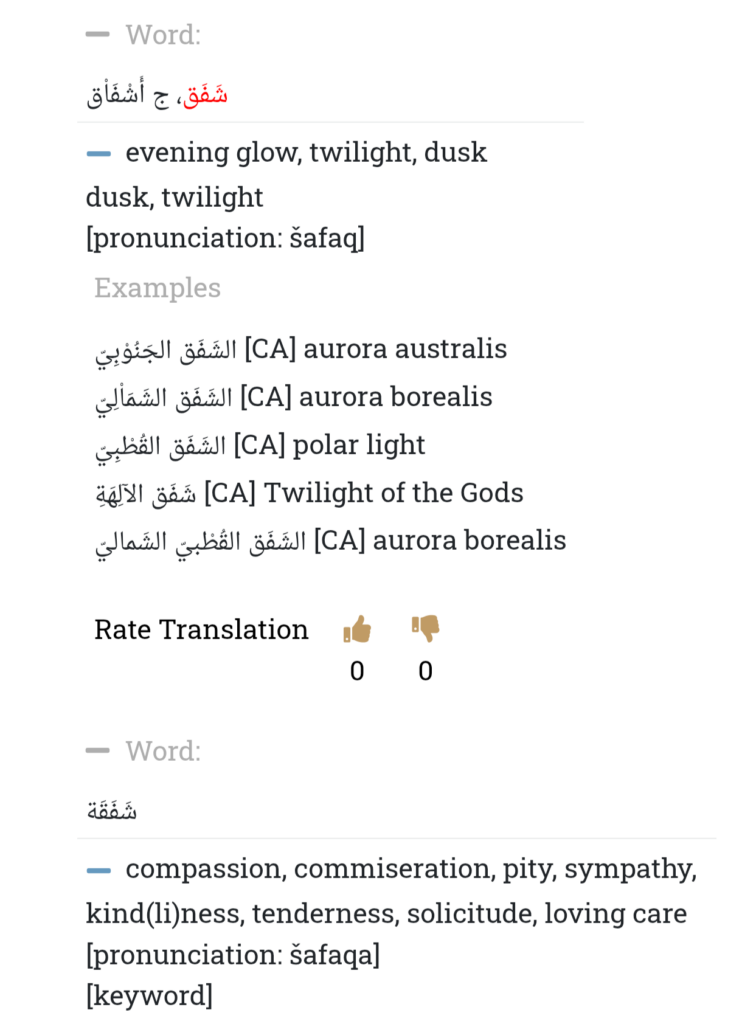
So these Muṣalleen are Mushfiqūn according to this set of verses. The word Mushfiqūn is plural of Mushfiq which would mean Sympathizer. Mushfiq comes from the root word Shafaq which as a verb means to Sympathise. Shafaq also means Aurora. Additionally, Ash-Shafaq is mentioned in the following verse:
ٱلقرءان سورة الانشقاق 16
فَلَآ أُقْسِمُ بِٱلشَّفَقِ
So I swear by the The Aurora
Al Inshiqāq (84), ʾĀyah 16
https://livingarabic.com/en/search?q=شفق
According to the following website, Shafaq means Aurora Twilight: https://www.kaheel7.com/ar/index.php/2010-02-02-20-06-04/448-2012-05-30-00-20-59
As per the first verse of Al Inshiqāq, which describes the splitting of the Sky, this verse is in reference to the Hour.
This verse proves that this Ṣalāh of the Muṣalleen who are Mushfiqūn is during the Hour.
A flame of Fire and Copper article explains The Aurora described elsewhere in the Qurʾān.
Qur’an 17:110 — Say, “Invoke all of you Allah or (inclusive or) invoke all of you The Rahman whilst what you all could invoke so for Him are The Titles of The Mastery”. And not could you boast (tajhar) by your Hearths (Salaat: singular, not prayers) and not could you hide (tukhafit) it. And seek (Ibtaghi, command) between that for you a path (denotes spatial orientation, not simply metaphysical)
https://www.instagram.com/reel/DaLkMLKtA_X/
The belief that missing Ṣalāh is worse than adultery, theft and fornication is the opinion of Ibn Qayim, it’s the reason why people like Hoblos say absolute nonsense like this, and it’s because Ṣalāh itself has been misinterpreted as something distinct and separate from being chaste and righteous as its been misinterpreted in a way that it’s a ritual prayer only and that you can do the ritual prayers and still be an adulterer, fornicator and thief, even though Ṣalāh itself and righteousness aren’t actually mutually exclusive.
Ibn al-Qayyim, said:
No Muslims are in disagreement [about the fact] that intentionally leaving obligatory prayers is from the greatest of sins and from the most major of major sins and that its sin is greater than the sin of murder or [unlawfully] taking [others’] wealth; than the sin of fornication and adultery, theft, or drinking alcohol–and that [the one who intentionally leaves a prayer] faces the punishment of Allāh and His wrath, His debasement in this life and the Hereafter.
Al-Albānī. Ḥukm Tārik Al-Ṣalah. Dār Al-Jalalain, 1412 H, p. 5.
Aṣ-Ṣalaah (Ṣalāh of the Mu’mins) is connected to the idea of being Ṣāliḥ (righteous), 7:170. Meanwhile the Ṣalāh of these mushrikeen these disbelievers is in vein.
Assumptions about the Ṣalāh
Since it’s near-impossible to know if the ritual prayers were mass transmitted from the Nabī or were just made highly popular by a consensus of scholars fairly recently in the past 180 years, it’s not appropriate to follow them as per verse 17:36 because 17:36 says don’t follow that which you have no knowledge of because your hearing, sight and heart will be questioned, the “heart” part likely refers to certainty (yaqeen) and reason (ʿaql), as in “did you really doubtingly have certainty about that which you have no knowledge of and couldn’t really prove but only was an assumption or were you being foolish (Jāhil)?” And since writing this question, there are also no exceptions for Jahl in the Qurʾān, it’s actually the opposite.
All the “QC” people following that which they don’t have knowledge of because “it doesn’t [directly] go against the Qur’an” and “it’s Sunnah of the prophet because of all sects practice it”, are basically upon kufr, and basically disobeying this command in 17:36, “oh but you got to do these practices that have consensus across all the sects to be a good person”, but that’s not what Hoblos said, he made a distinction between Ṣalāh and righteousness that even if you aren’t righteous you have to do Ṣalāh and you are better than the righteous person who doesn’t do Ṣalāh, but there is good reason to disagree with him, but at the same time these practices as in this specific way of praying as in 5 daily prayers with rakaat and nāfil doesn’t specifically make a person righteous, it may just distract them from doing unrighteous deeds but it doesn’t change their heart and mind to be righteous, it’s seemingly just a good distraction until it no longer isn’t which is a slippery slope to be on. Righteousness only comes by making the effort to do righteous deeds and desiring to do right.
Most of the people who insist that Ṣalāh is daily ritual prayers where they have to put their head on the ground with their butt in the air have the tendency to insult in one way or another over something different or the topic of Ṣalāh itself, not upholding righteousness.
Ṣalāh is something else, that about kindling righteousness in the heart and being righteous, reciting a few verses on a prayer mat doesn’t guarantee righteousness, righteousness is intentional, it’s not that reciting a verse will definitely result in a mantric effect that makes the person righteous.
Indeed, not everything the forefathers did, people have to suddenly do the opposite, indeed the Qurʾān talks about the negatives in following their forefathers in terms of belief and understanding. Though in regards to Ṣalāh, it would be better to do the opposite because first of all the 5 daily ritual prayer people say it’s an [obligatory] religious practice, but it’s not mentioned in the Qurʾān [e.g. putting the head on the ground with butt in the air is not described in the Qurʾān], and they say that it’s valid just because a lot of people are doing it across all conflicting sects and no one has questioned it, but then why is it not in the Qurʾān, why is putting the head on the ground and butt in the air not described in the Qurʾān? Indeed it’s not, even though it’s called a religious practice, so it must be wrong to do it by following the majority, because they’re following and doing something as a religious practice that’s not mentioned in the Qurʾān, and since no one today knows if the Nabī actually did it or not, and there’s no way for me to confirm that to reach yaqeen, it cannot be practiced it as per 17:36, and also 6:116 and 10:36. 6:116 and 10:36 together with 17:36 clearly prohibits following the majority about that which they don’t know about and just assume. The Ṣalāh of the majority is different to the Ṣalāh mentioned in the Qur’an.